.png)
March 5, 2026

5 Minute Read

.png)
March 5, 2026
5 Minute Read
Most traders believe their lack of success comes from not having the “right” strategy. They constantly switch indicators, timeframes, and systems, hoping the next setup will finally work. In reality, the majority of traders fail not because their strategies are bad, but because they are unable to execute them consistently. A strategy only exists on paper until it is executed correctly in live market conditions. Without disciplined execution, even the best strategy loses its edge and becomes unreliable.
A trading strategy outlines what to do: where to enter, where to exit, and how much risk to take. Execution is the process of turning that plan into real trades under pressure. This is where most traders break down. Markets move fast, emotions rise, and hesitation creeps in. When execution slips—entering late, exiting early, or skipping trades—the strategy’s statistical advantage disappears. Execution is not a secondary step; it is the mechanism that allows a strategy to perform as intended.
Many traders underestimate how damaging small execution mistakes can be. Missing a few entries, adjusting stops emotionally, or closing trades too early may seem harmless in isolation. Over time, however, these small deviations compound and distort results. A strategy that looks profitable in backtesting can turn unprofitable in live trading simply because it is not being executed consistently. These hidden execution errors slowly erode confidence and make traders question strategies that may actually be sound.
Fear and greed are powerful forces in live trading. Fear causes traders to hesitate, cut winners short, or avoid valid setups after losses. Greed pushes traders to overtrade, increase risk, or hold positions longer than planned. These emotional responses override logic and discipline. Even experienced traders struggle to remain emotionally neutral when real money is on the line. The inability to control emotions is one of the main reasons execution breaks down—even when the strategy is clear.

Consistency is what turns trading into a measurable process rather than a guessing game. When execution is consistent, results become predictable and data-driven. Traders can evaluate performance objectively, identify weaknesses, and improve logically. Without consistent execution, it is impossible to know whether a strategy truly works. Discipline in execution creates clarity, reduces stress, and builds long-term confidence in the trading process.
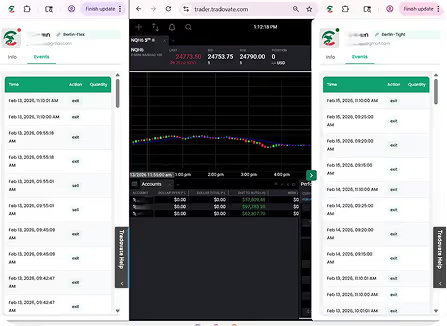
Automation addresses the core execution problem by removing emotional interference and manual delays. When trades are executed based on predefined rules, the system follows the plan exactly—every time. Automation does not replace strategy or decision-making; it protects those decisions from fear, hesitation, and impulse. By automating execution, traders can ensure their strategies are applied consistently across all market conditions, allowing the true performance of the strategy to emerge.
A great strategy without disciplined execution is incomplete. Many profitable traders succeed not because they have complex systems, but because they execute simple strategies exceptionally well. Execution is what transforms ideas into results. Focusing on execution first allows traders to gain control, reduce emotional stress, and trade with greater confidence. Strategy refinement becomes far more effective once execution is stable and consistent.

Disclaimer : Trading in financial markets involves risk and may not be suitable for all investors. Craft Trading does not guarantee profits or specific trading results.